Tieshan Zhi Vol. 3 — Changhe Ji
After embarking on the Tieshan Zhi creative project, I came across several texts: the History of the Hsu Family written by Hsu Yun-Yuan, the "love of plants" stele inscription composed by Hsu Tian-Te, and the Tiefeng Shanfang Changhe Ji (Anthology of Poetic Correspondence of the Iron Peak Studio), written and published by Hsu Tian-Kui.
Old-Road Photography
At first, what struck me was a route described in the History of the Hsu Family:
其時,后里地方並無水田可耕(中略)清早出門往東勢收買藤條,一擔擔回后里,隔日又是清早往大安港,售給唐山船;回時買一擔鹽回后里,隔早又擔往東勢出售,如此繼續不休。 ——— At that time there were no paddy fields to farm around Houli (passage omitted). Setting out at dawn for Dongshi, he would buy up rattan canes and shoulder a load back to Houli; the next day, again at dawn, he set off for the Port of Da'an to sell them to the junks from the mainland, and on the way home bought a load of salt to carry back to Houli; and the following dawn shouldered it once more to Dongshi to sell—and so it went, on and on without rest.
This passage describes the trade route along which the Hsu family's pioneering ancestor, while living at Maozaikeng in Houli, threaded his way between the mountain and coastal lines of central Taiwan—rattan canes carried from Dongshi on the mountain line down to the Port of Da'an on the coast, and salt carried back the other way. In terms of today's administrative divisions, the route would pass through Dongshi, Houli, Waipu, Dajia, and Da'an—roughly the extent of the Houli Plateau. It is a route I know well, for since Waipu is where I make my work, I am often out on my scooter across the Houli Plateau, taking photographs. Once this dawned on me, I began to wonder how the route might be brought into relation with photography.
I began to study the literary works of Hsu Tian-Kui and Hsu Tian-Te, and found that much of what they wrote had to do with the things of the Houli Plateau. I live in the same region as these literati of a hundred years ago; in words they set down their thoughts and feelings about living in this place, and for me that medium is photography.
The phrase "old-road photography" surfaced in my mind, and I began deliberately photographing along the route. As the project went on, I gradually came to feel that photography had become a kind of bridge, joining me to these works of literature.
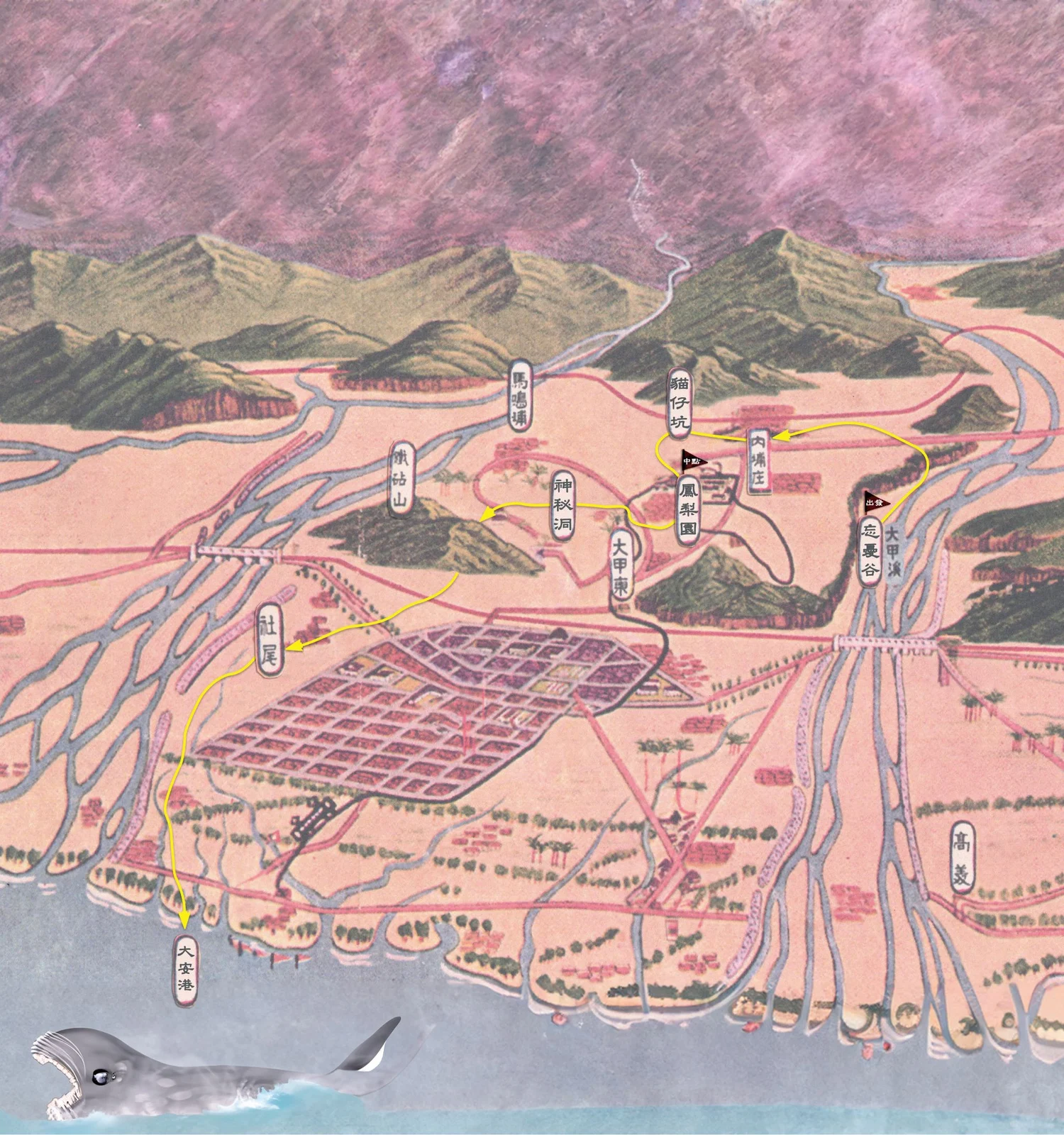
This image is a schematic map of the old-road photography route: setting out from Wangyou Valley beside the Dajia River, it runs west from Houli, passing the pineapple garden, the Mystery Cave, and Tiezhen Mountain, and at last reaches the Port of Da'an.
Crossing the Dajia River in Rain
Camera in hand, I set out from Waipu on my scooter. Riding from the southern side of the Houli Plateau toward Wangyou Valley, I could look north and make out Tiezhen Mountain; along the road the rows of bamboo swayed up and down in the wind, like a crowd of people bowing without end. There was a house by the roadside, a great grove of pines before its gate, the needles drifting down in the wind like a fine green rain. Across from the house stood a Zen temple, wrapped in stillness, where a Buddhist nun was sweeping the ground outside. I came to the floodplain of the Dajia River. In the rainy season, the rushing Dajia was a natural barrier that those before me struggled to cross. Hsu Tian-Kui once wrote a poem, "Crossing the Dajia River in Rain," telling how hard it was to ford the river in his day; the poem is also an allegory for the inner conflict he felt serving in officialdom under Japanese colonial rule.
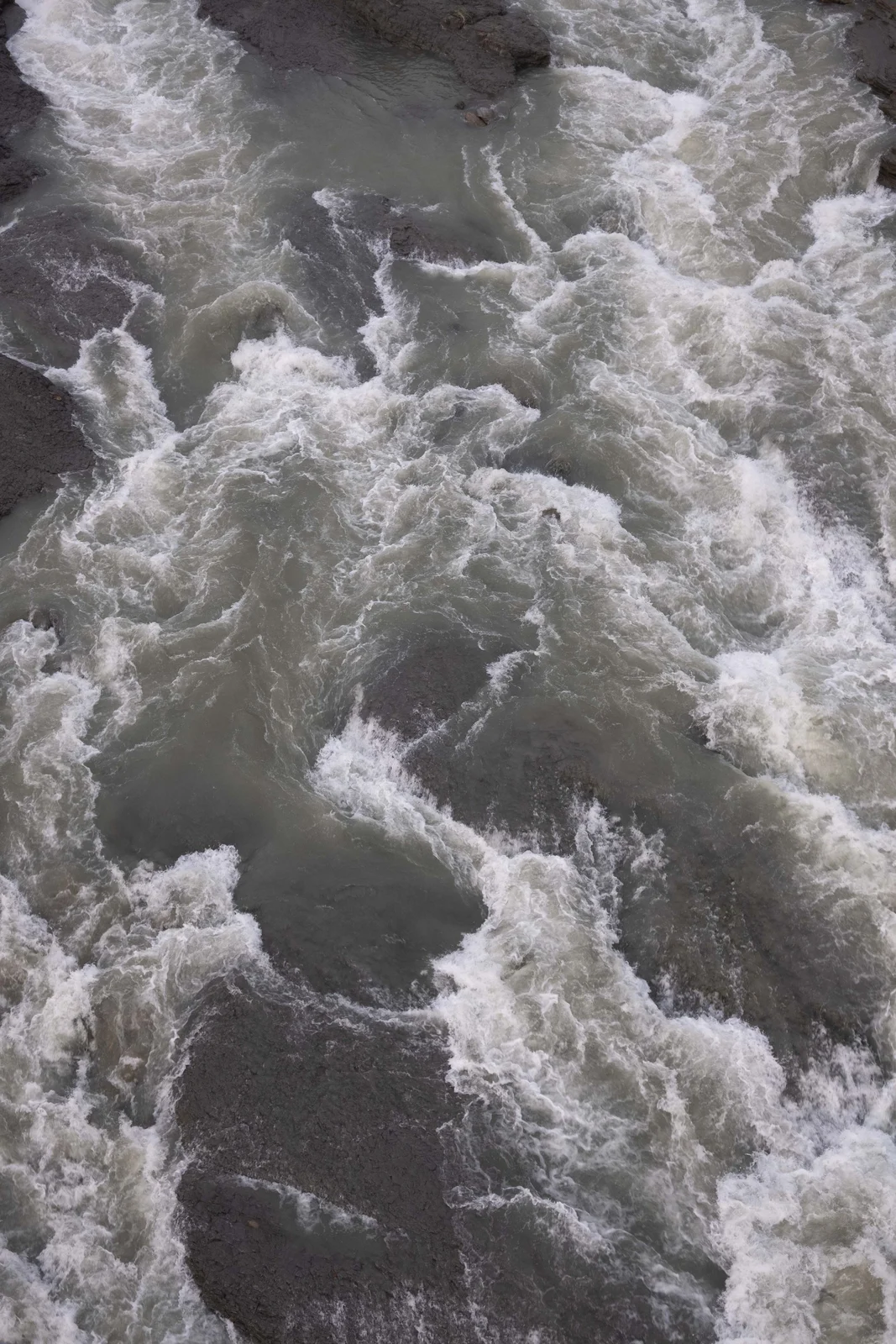
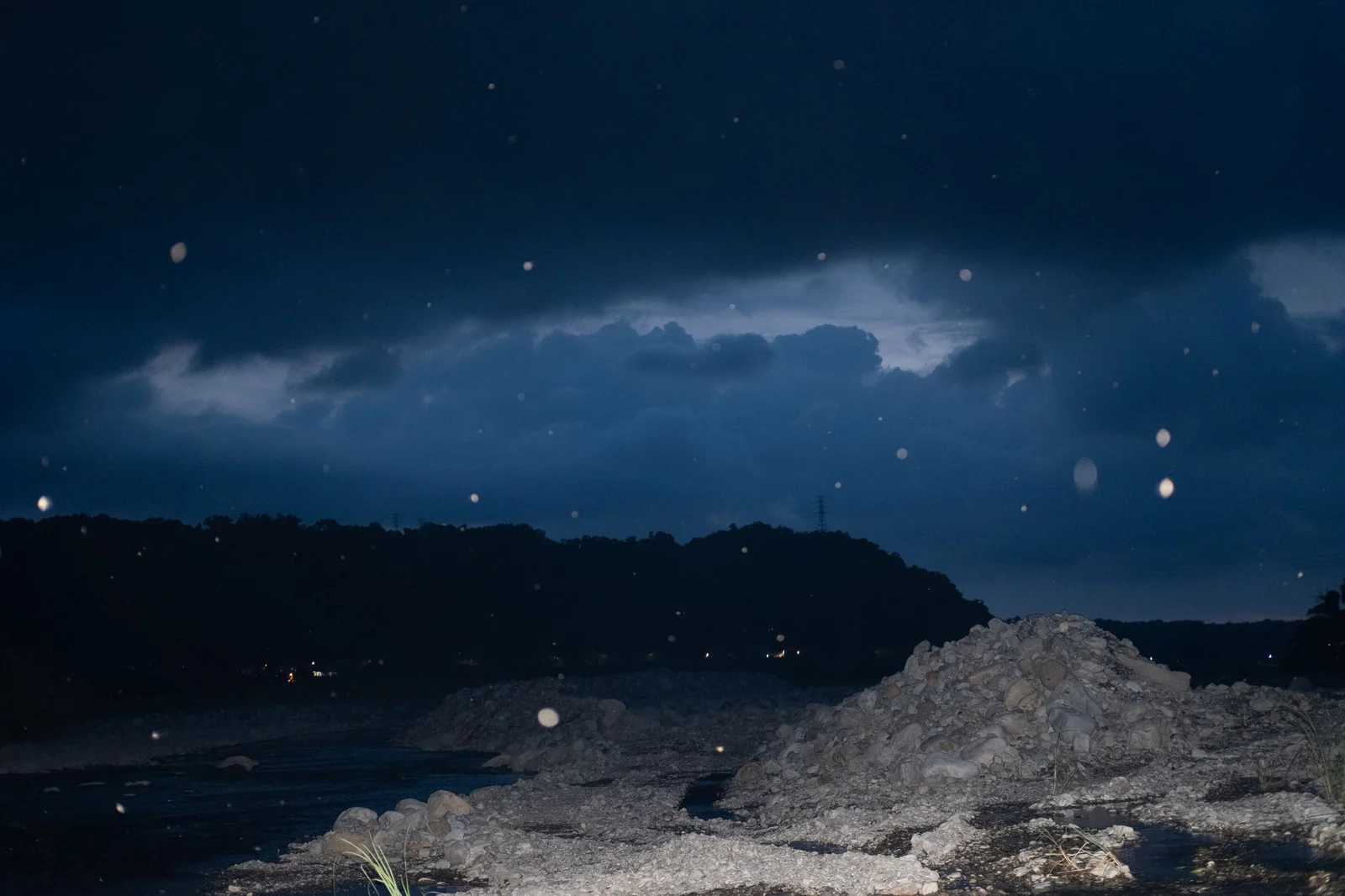
"Beyond the hills a light rain is falling still; the fearsome waves race toward the river's mouth,
the broken bridge, washed away, draws no traveler; the little skiff on the river pitches wildly, chilling the heart,
the swift current beats without rest at a boulder on the verge of toppling, and the swollen waters leave their mark upon the collapsed sand dunes,
yet however treacherous the waters, I am resolved still to cross this river."
Turning our gaze from the Dajia River back to our journey, we went on eastward along the floodplain. To the left lay a broad sweep of rice fields; to the right, the embankment of the Dajia River. Along the way one meets herds of goats grazing the wild grass of the wasteland, the herders in their bamboo hats, short staves in hand, watching from a distance. At times one comes upon an excavator poised like a praying mantis, raising its sharp foreleg to hack down a tree that has long since taken root in this land.
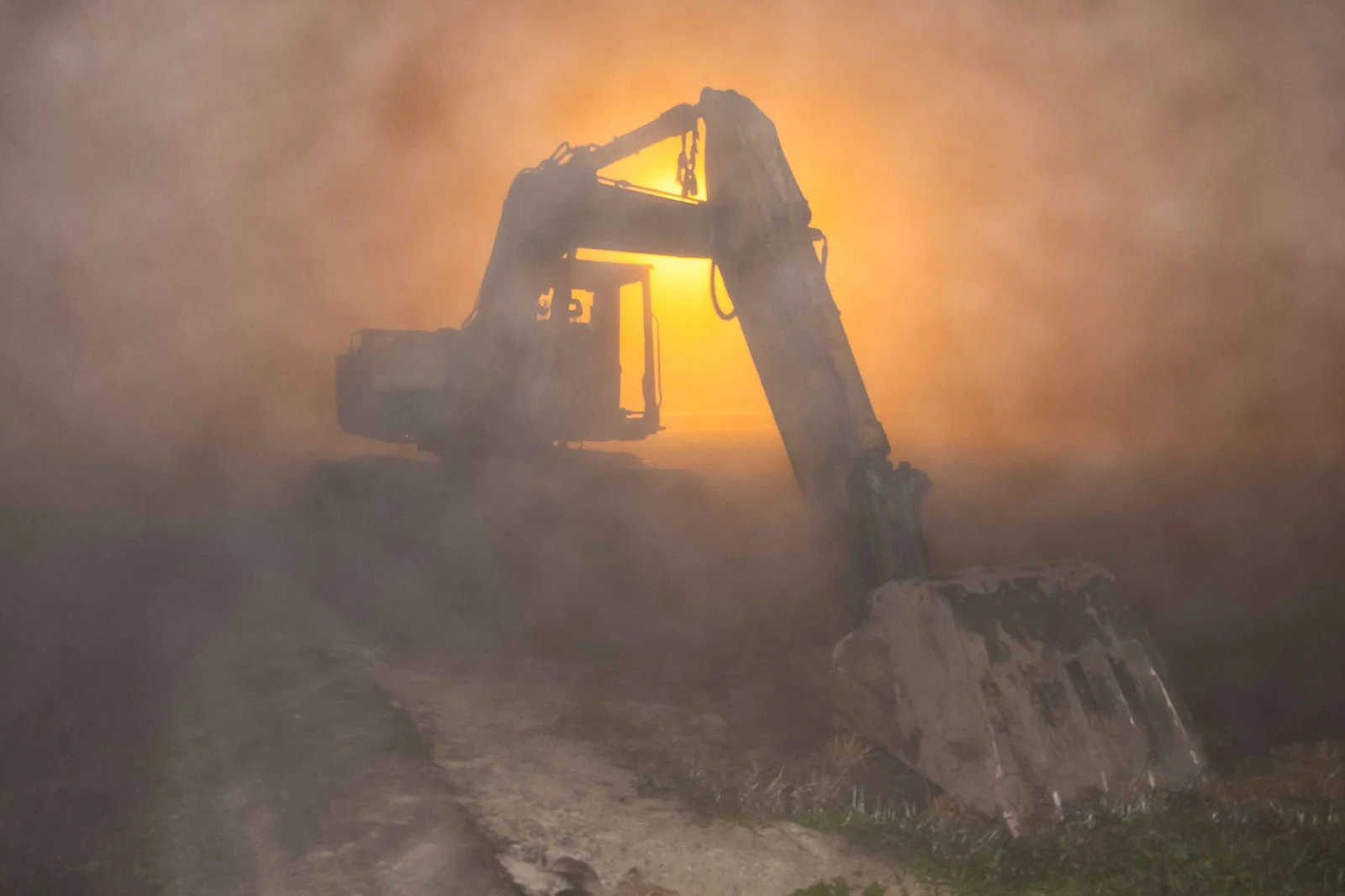
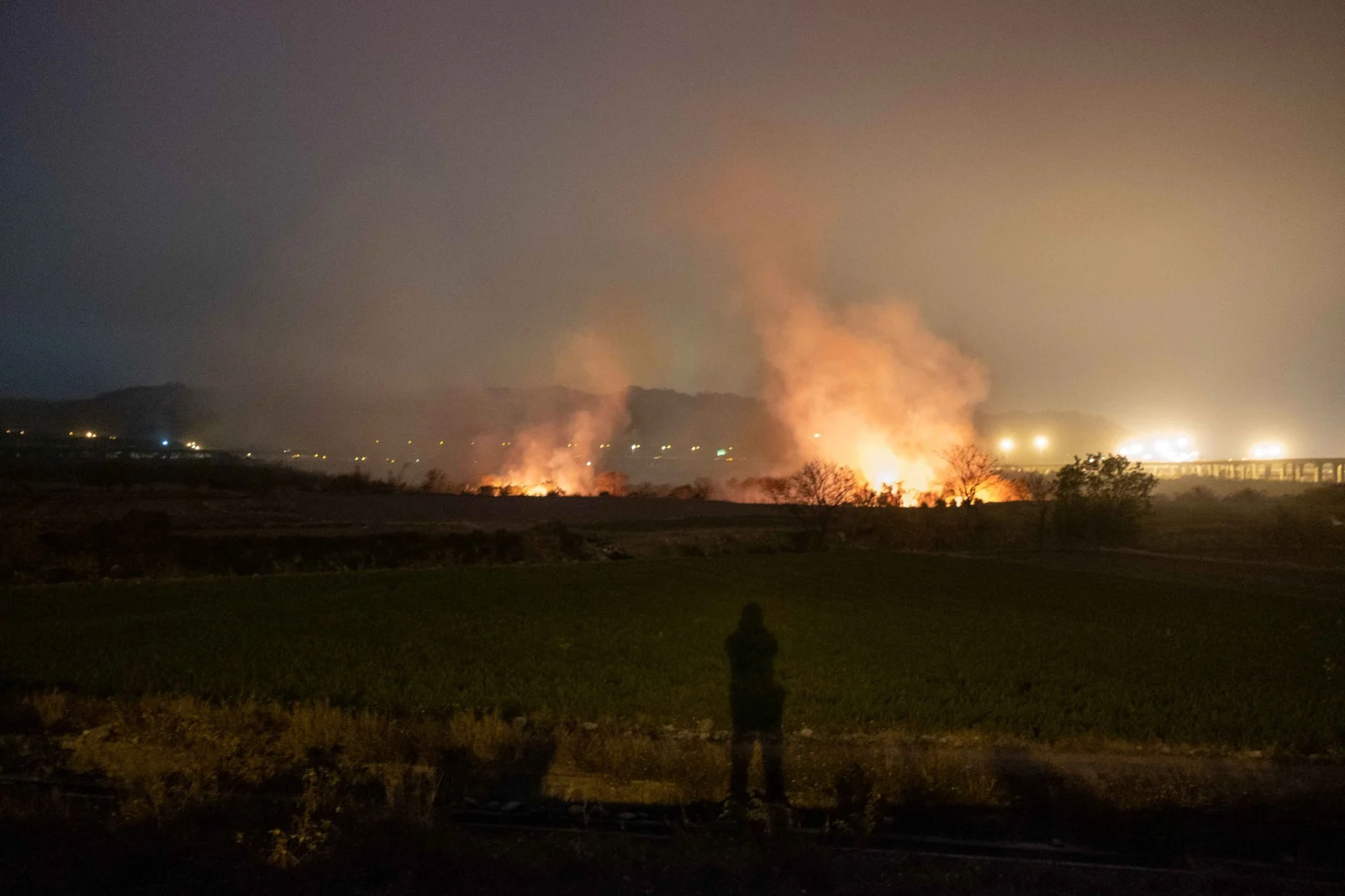
Every summer, the drought wrings the moisture from the plants of the valley until they are all but desiccated. At such times the smallest spark is enough to set the whole valley ablaze. This stretch of floodplain, called Wangyou Valley, kindles into fierce flame on summer nights, glowing in answer, from afar, to the headlights strung along National Freeway 3.
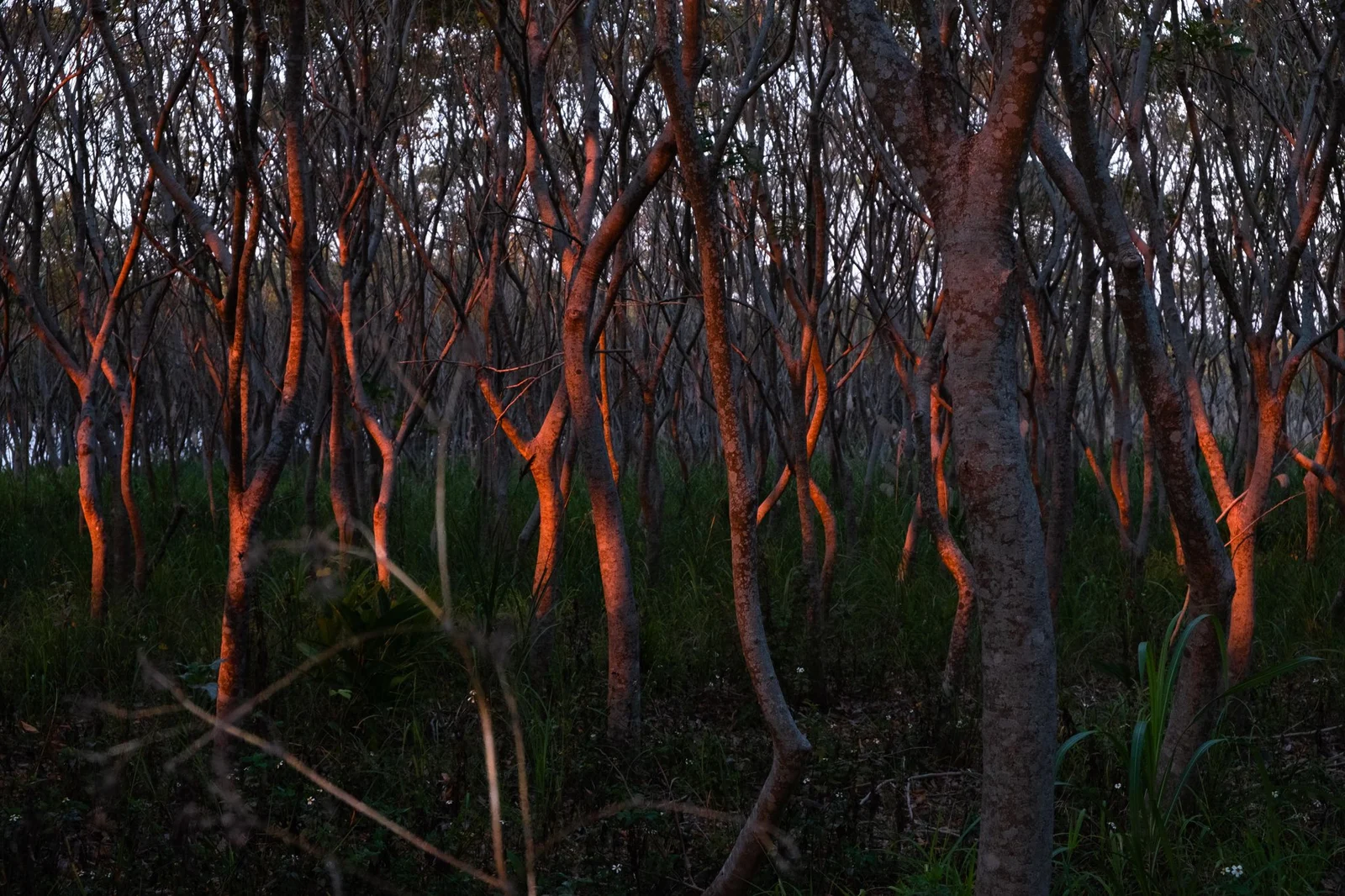
At the easternmost edge of Wangyou Valley stands a great boulder, some six feet high, its face sprayed in red paint with four large characters: "Democracy is dead." After taking in the stone, I rode north, back onto the Houli Plateau, where a soapberry grove stretched beyond sight. The orange winter sun warmed the trunks of the trees, which stood like a troupe of dancers at sundown.
Love of Plants
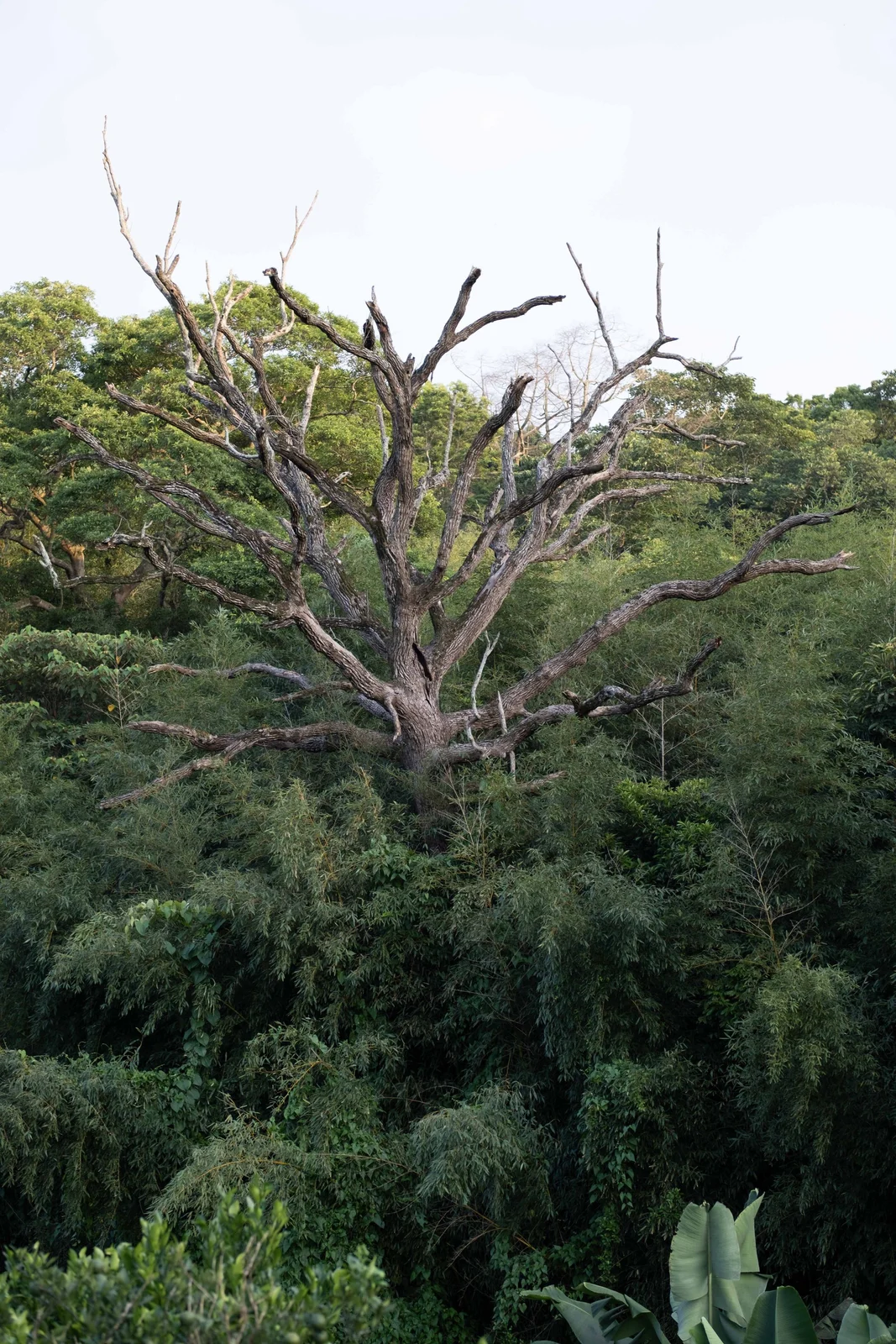
After winding my way out of the soapberry grove, I turned onto Jiahou Road, and following it to its eastern end I came upon Houli Station; a left turn from there led toward Maozaikeng. Riding south along the main road of Maozaikeng, I reached a grove planted with orange trees—the farthest point a scooter can go. After parking, I walked into the orchard, where green and yellow intermingled, and in the dense green woods beside it a withered, ashen dead tree still straining toward the blue sky.
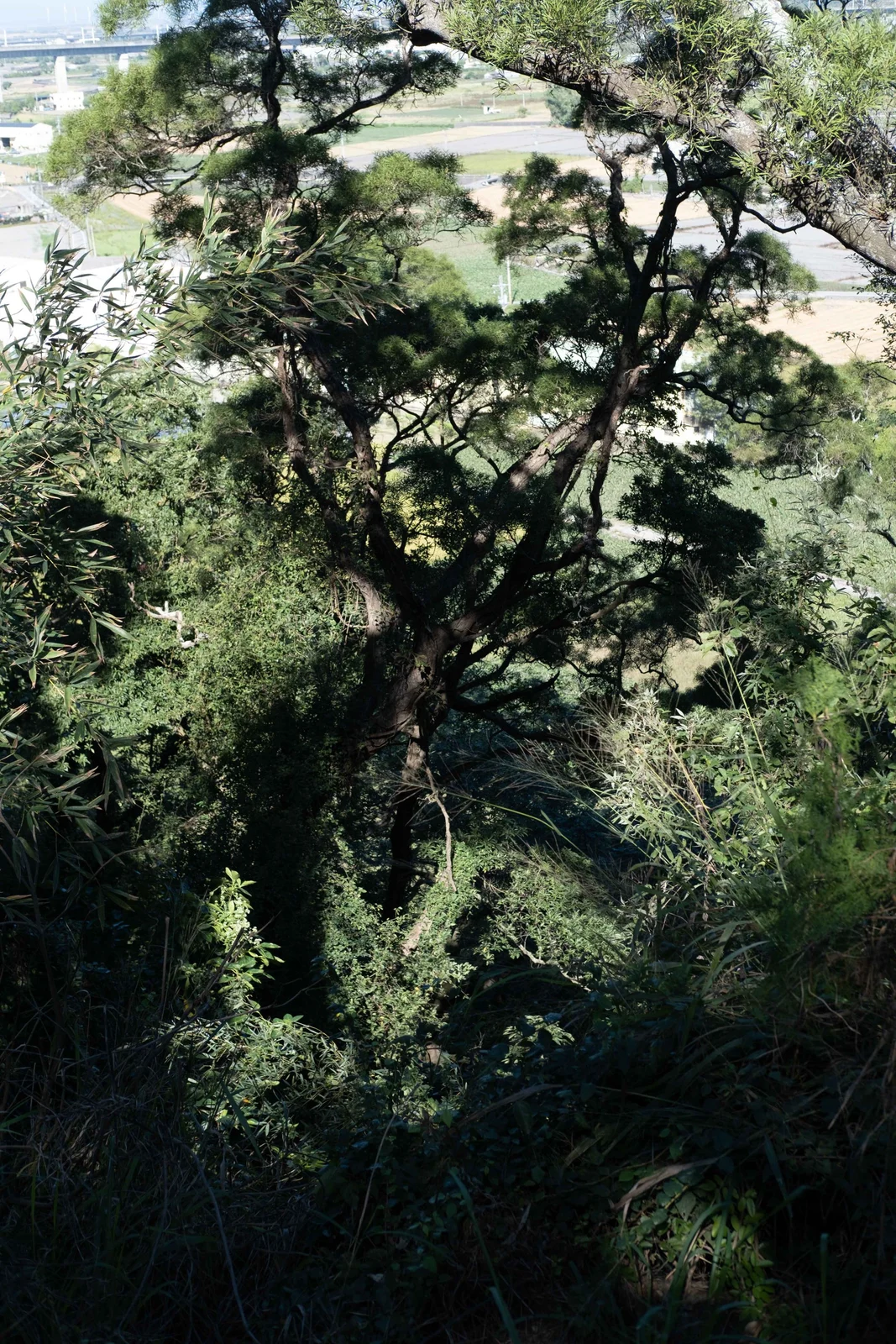
At the turn from autumn to winter, the haze that had hung over the whole year lifted, and the ridgeline of the Xueshan Range, east of the Houli Plateau, ran on into the clear, cold air. The brilliant sun lit the mountains, rivers, and plants of the plateau; red earth and green trees, wrapped in blue sky, each blazed with its own color in the light.
Leaving Maozaikeng, I rode west toward Waipu. At the midpoint of the old route stands the "love of plants" stele, its inscription composed in 1936 by a member of the Hsu family, Hsu Tian-Te.
夫草木之類繁多世之學者難罄其奧如大者參天蔽日小者箘生細眼莫查而吾人資為糧食衣住器抑直接間接莫不利用賴以生活者於戲植物資予吾人其功之大莫得而名也矣 斯園自闢草萊亘歷十幾星霜乃區劃阡陌略就有序栽果之餘並蒔群芳影竹風松丹楓碧柳桃腮杏臉嫣綠嬌紅終年伸展還似首陽薇蕨大宛蒲萄因時亦發每逢季節遷移尤多興懷而感念造物表現於植界之大不可仰止也夫 維茲植物茁芽伸幹開花結實生生在理故願吾人體同有生益復輸情秉心加護而刀斧以時攀折以度竊定年年仲春佳辰薄餚醪飲于斯間祝他生日如同盛事僶望來者勿嗤其謊繼和其後歷世不渝其作有加至為緬仰爰 諸石聊誌其意云爾 ——— Manifold past all numbering are the tribes of grass and tree, and the learned of this world can never exhaust their mystery. The greatest stand propping heaven and curtaining the sun; the least spring up as motes of fungus that the closest eye cannot descry. Yet from them we take our food and raiment, our dwellings and our tools; directly or at one remove, there is nothing of theirs we do not use, and by their grace we live. Ah—what the plants bestow upon us is a bounty too great for any name. Since first this garden was cleared from the rank wilderness, ten and more rounds of star and frost have passed; its paths and plots were drawn by degrees, until a rough order emerged. Fruit trees once set, we sowed besides a host of flowers: shadowed bamboo and wind-voiced pine, crimson maple and jade-green willow, peach-bloom cheeks and apricot faces, tender reds and melting greens unfolding the whole year round—and like the bracken of Mount Shouyang, like the grapes of Ferghana, each puts forth in its appointed hour. At every turning of the seasons the heart is stirred the more, and we ponder with thanksgiving how vast is the Maker's hand revealed in the green kingdom, beyond the reach of our upturned gaze. Now these plants bud and stretch their stems, flower and set their fruit—life begetting life, as reason ordains. I would have us, then, own them fellow-sharers in life, pour out to them a still warmer affection, and bend our hearts to their keeping: let axe and hatchet wait upon the season; let plucking and breaking keep within measure. And I have privately appointed that each year, on a fair day of mid-spring, with plain dishes and unstrained wine we shall drink here among them and keep their birthday as a high festival. Earnestly I trust that those who come after will not laugh this away as fond nonsense, but will take up the refrain behind us, unswerving through the generations and adding ever to the work—a thing worthy of long and reverent remembrance. Wherefore I set these words upon stone, to record, in brief, my meaning—and no more.
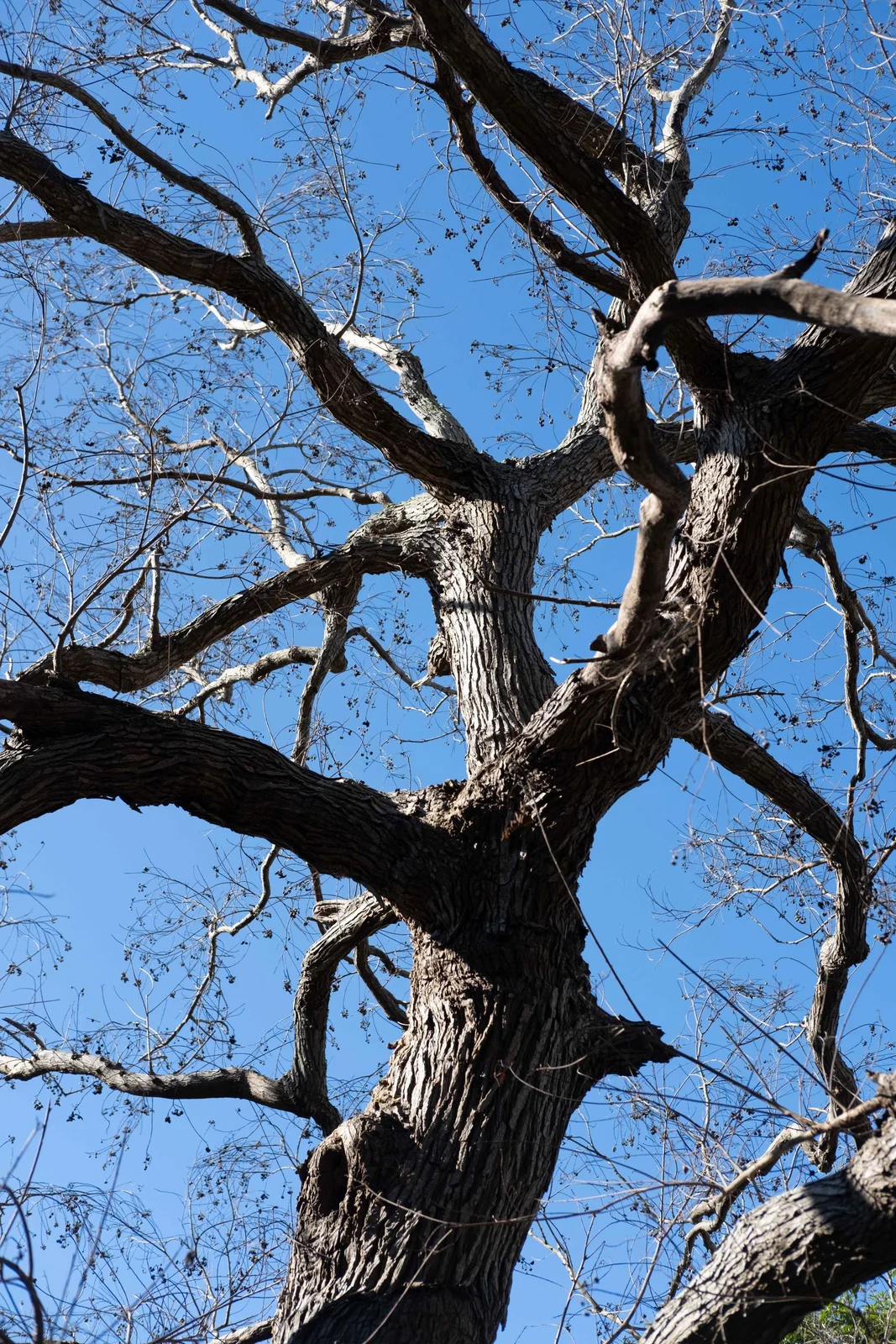
In this inscription Hsu Tian-Te gives voice to his wonder at the diversity and importance of plants, observing that even scholars find it hard to fathom their mysteries in full. Plants, great and small, bring direct or indirect benefit to humankind, giving us food, clothing, shelter, and more. Hsu Tian-Te describes his own garden, which after many years of cultivation is now planted full of fruit trees and flowers of every kind—bamboo, pine, and the rest. These plants change with the seasons, revealing the grandeur and mystery of the natural world. Human beings, he urges, should learn the rhythms by which plants grow, should cherish and protect nature, and should celebrate the life of plants each spring—in the hope that this spirit and practice might be carried on by later generations. To this end Hsu Tian-Te set down these words, to convey his awe of, and gratitude toward, plants and the natural world.
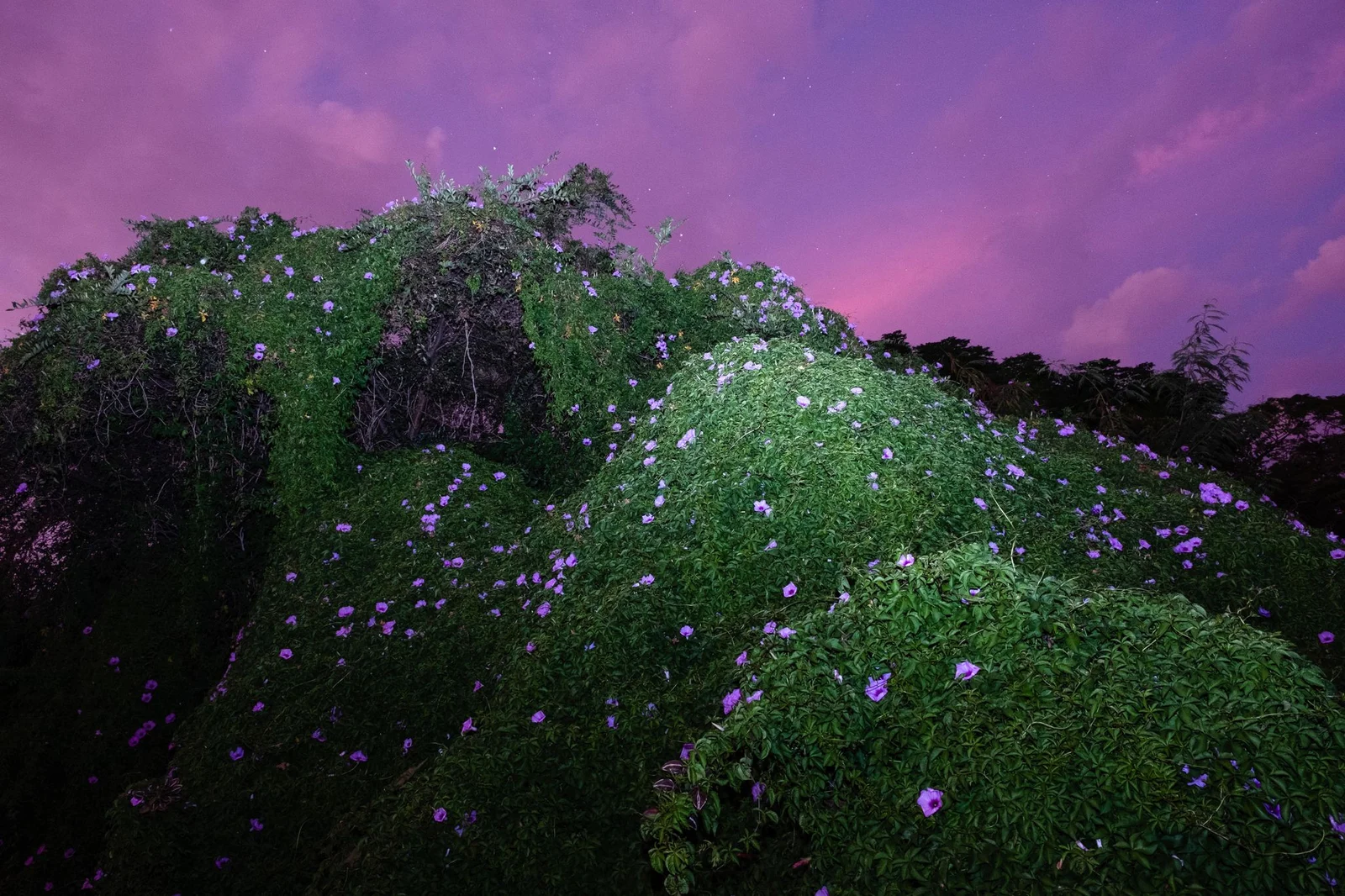
The "love of plants" stele sits on Meishan. East of Meishan lies a vast cemetery, its bounds held in by retaining walls. Over these walls grow purple morning glories. On the eve of the northeast monsoon, the purple sunset of early winter casts its light across the drifting layers of cloud, blooming together with the flowers below.
Reflections on Crossing the Da'an River
Setting out from Meishan I rode west, and after passing Mamingpu went on toward the unpeopled stretches. Then I came upon a signpost reading "to the Mystery Cave," set beside an unremarkable little road; one has to dismount and walk in along the footpath.
At the midpoint of the trail the path forks in two. One branch leads to a viewing platform, from which one looks out over the broad rice fields of the south bank of the Da'an River. In the fallow season each paddy takes on a different color: some the green-gold of sunflowers, some the orange-red of cosmos, and more often a bare earth strewn with the deep-brown stubble of cut straw. Beyond rises Mount Huoyan—gullied and furrowed, draped in green or bared to its red earth—its foot meeting the dried-up bed of the Da'an River.
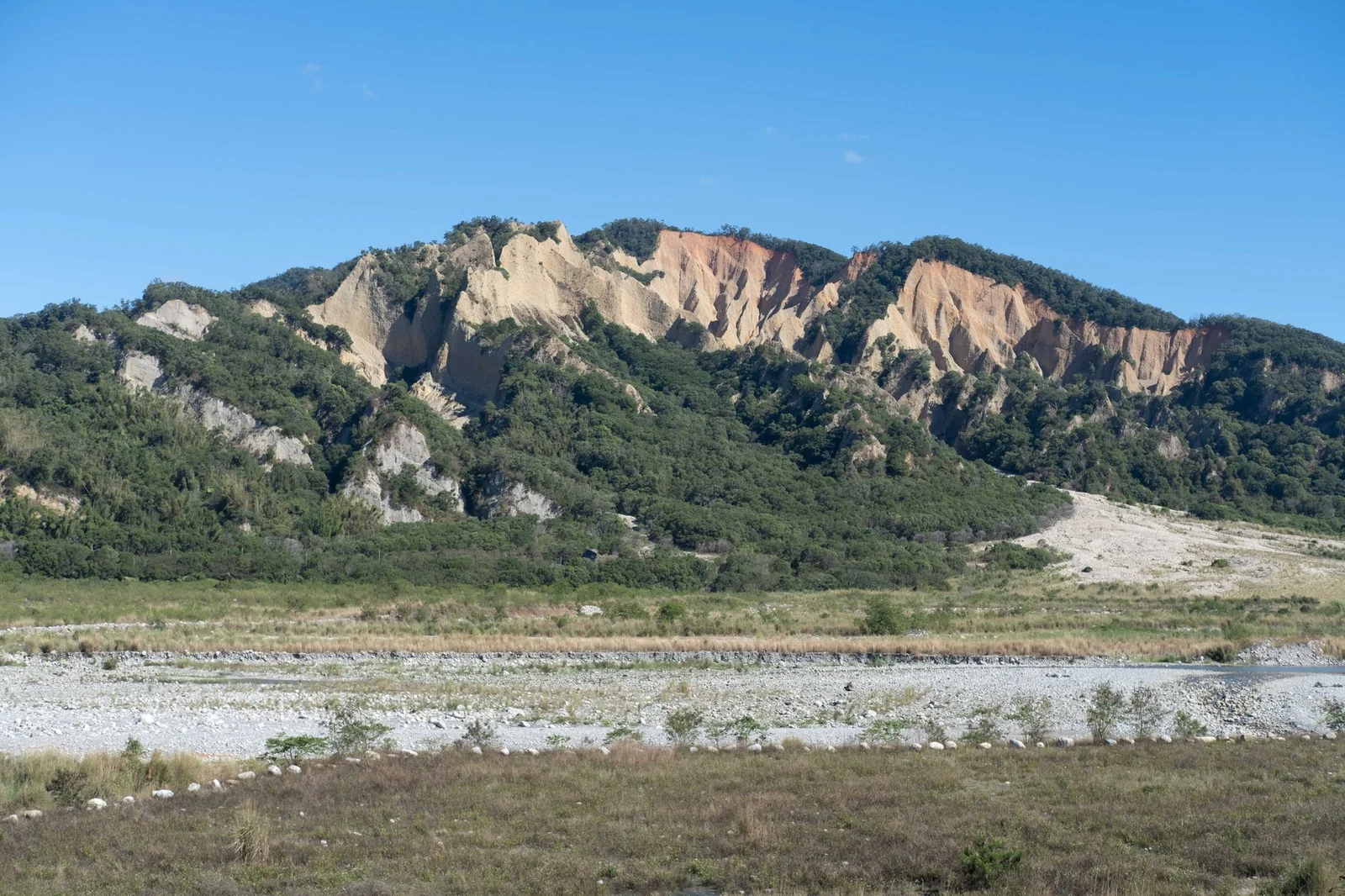
Hsu Tian-Kui once described the terrain along the Da'an River in a poem, "Reflections on Crossing the Da'an River":
Through its picture of the Da'an River and its surroundings, the poem reflects the changes of history and the vicissitudes of the age, suggesting that beneath a placid surface the events of the past leave their traces still, shaping the present and the days to come.
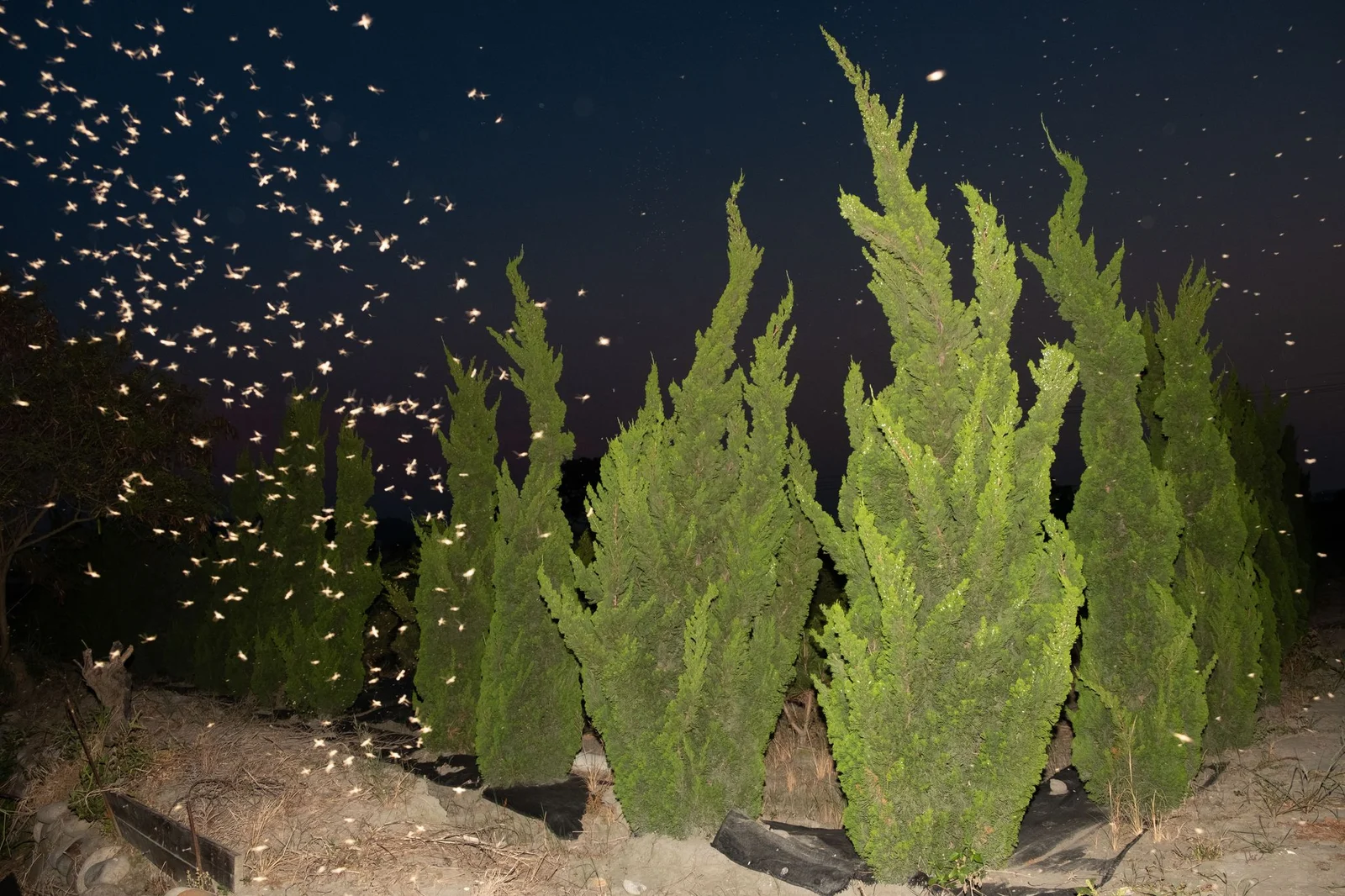
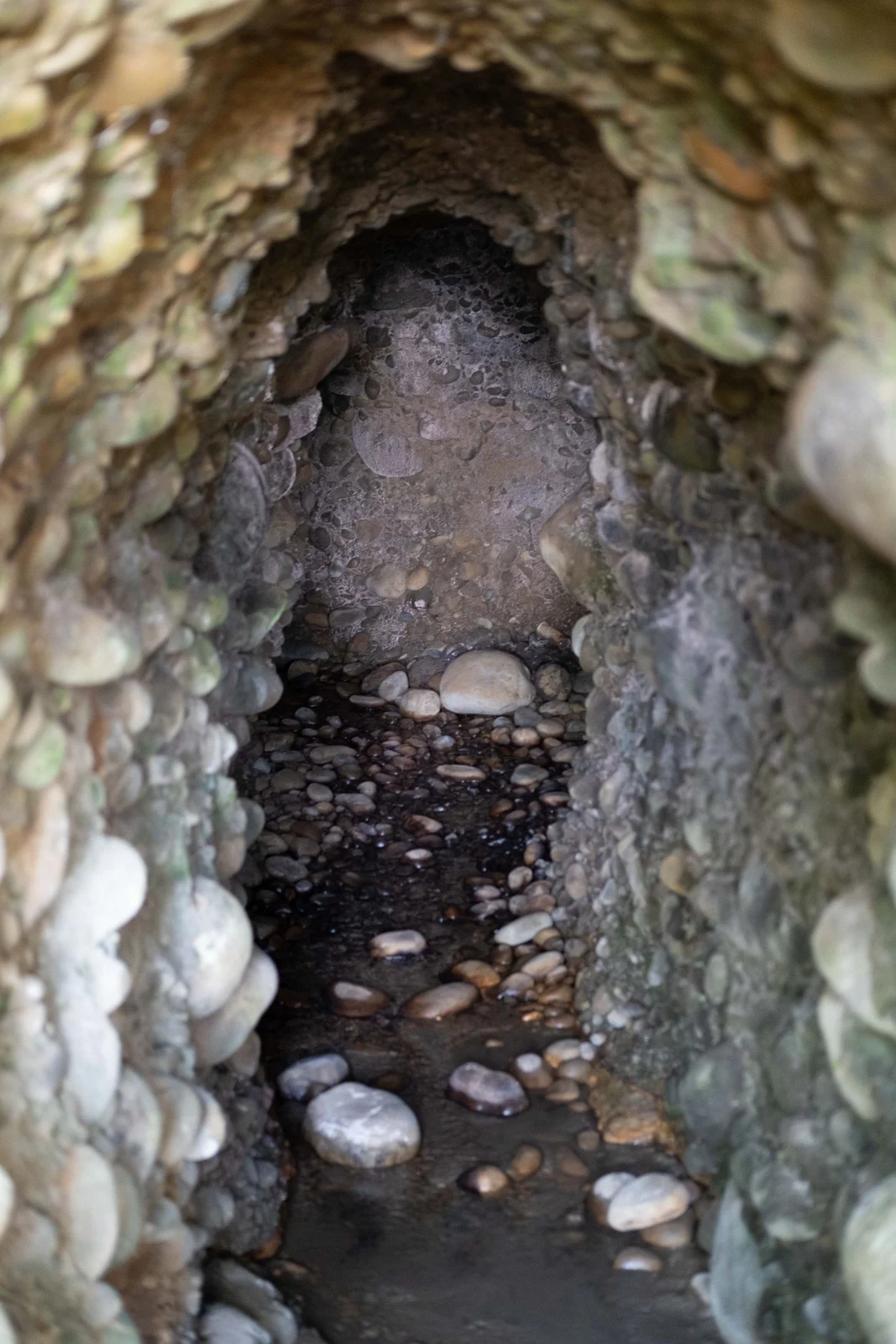
The other branch of the trail leads downward, and after about a minute's walk the Mystery Cave comes into view. Built up of cobblestones, the cave, seen from the mouth, is like the gaping maw of some monster, its throat studded with fleshy lumps, ready to swallow any who trespass. Lean in for a look, and the drip-drip of falling water sounds now near, now far. When the north wind pours in, a low droning rises endlessly within, forming with the dripping water a slow and somber duet.
Meditation on the Past at Tiezhen Mountain
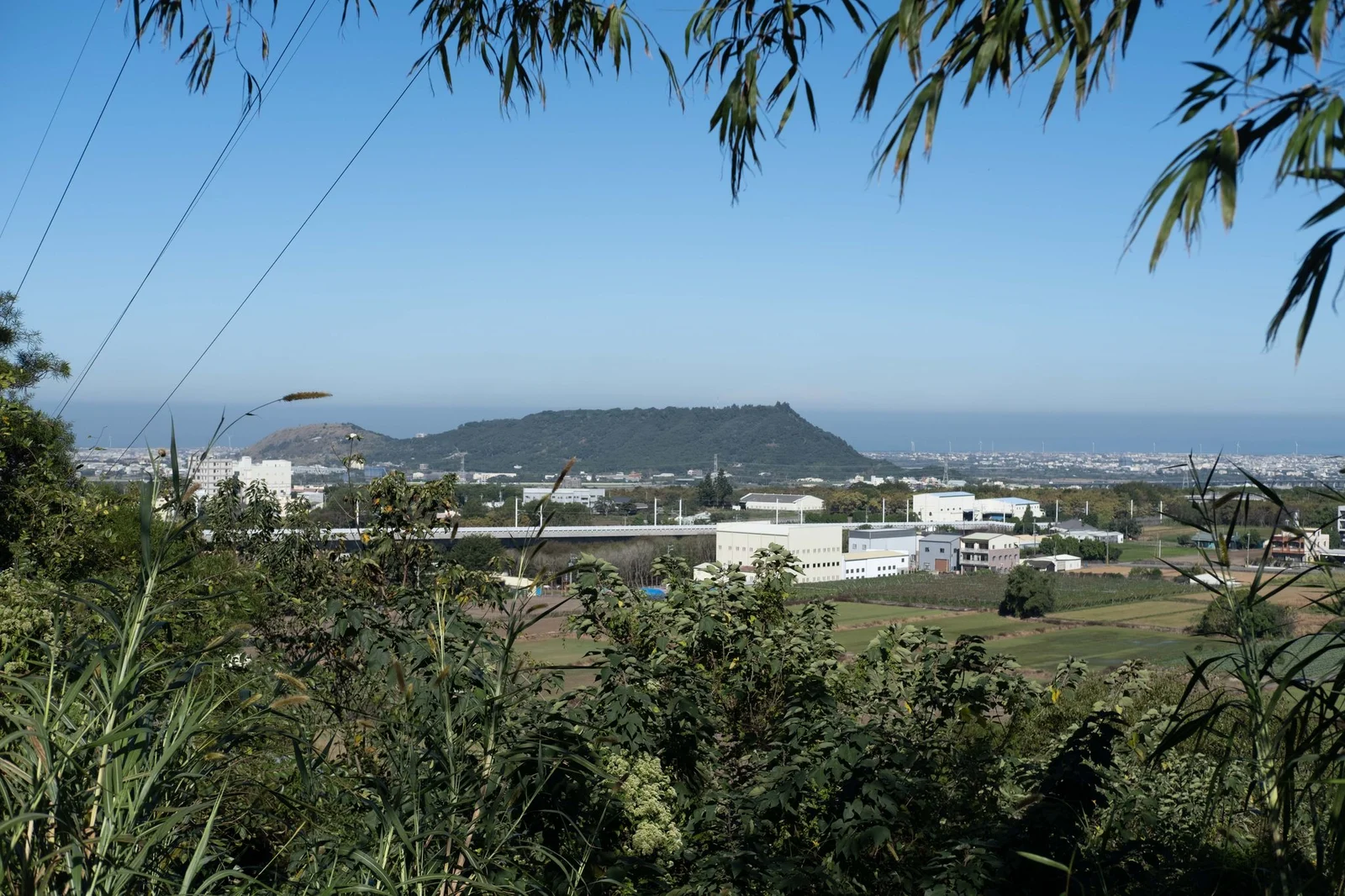
As I continued downstream along the Da'an River, a striking summit drew nearer and nearer. Seen from the open sea beyond the Port of Da'an, the shape of the mountain resembles the anvil a blacksmith uses to forge iron—tiezhen, in Chinese—and so it is called Tiezhen Mountain.
Reaching the southern side of the foot of Tiezhen Mountain, I followed a small road west, with paddy fields and graves along the way. It was early spring; the paddies had just been set with seedlings, and Qingming had only lately passed. On the graves, weeded and tidied, fresh flowers still lay, and where the soil had been turned, a scent that belongs to the earth seeped into the faintly floral air.
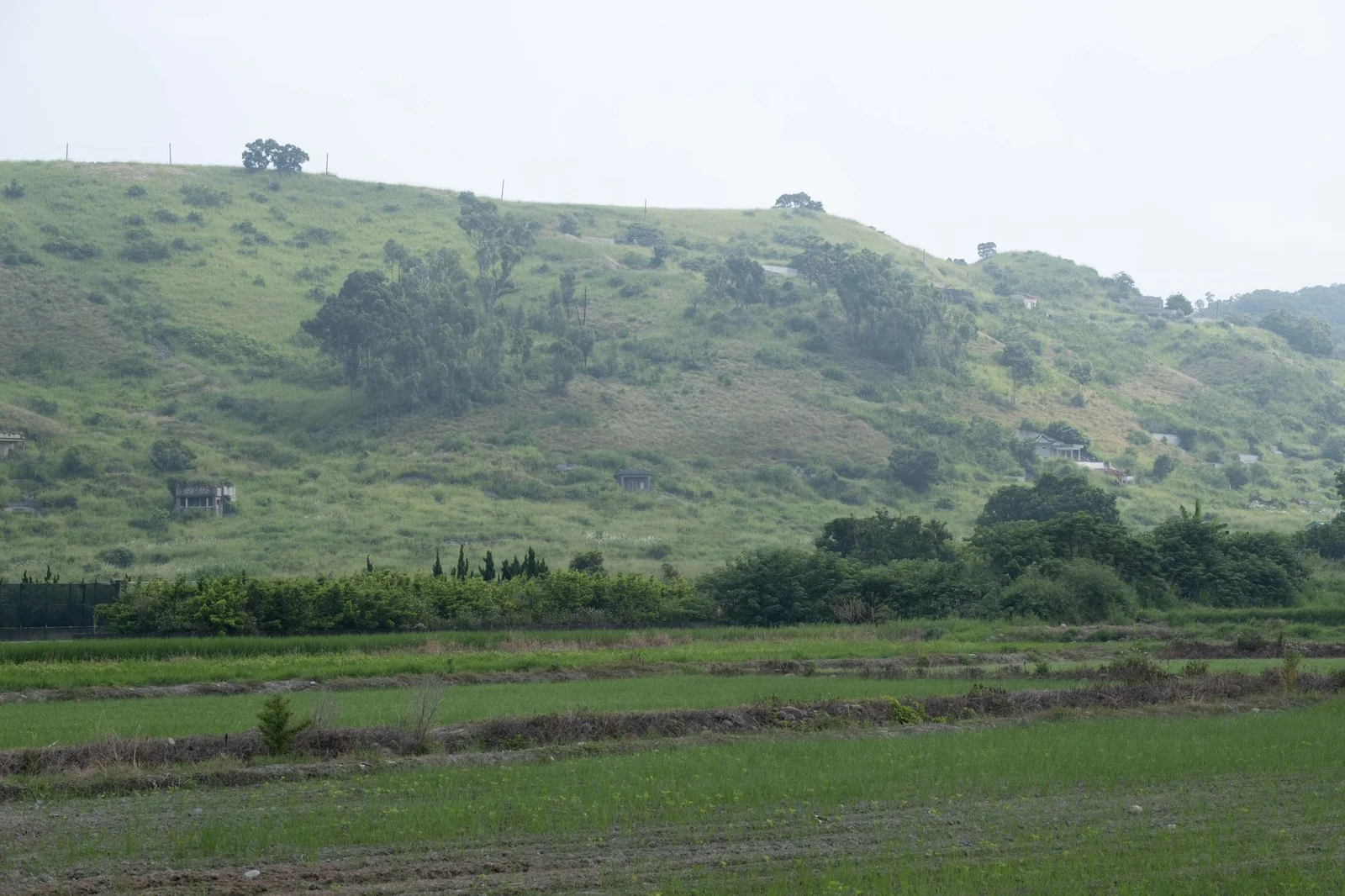
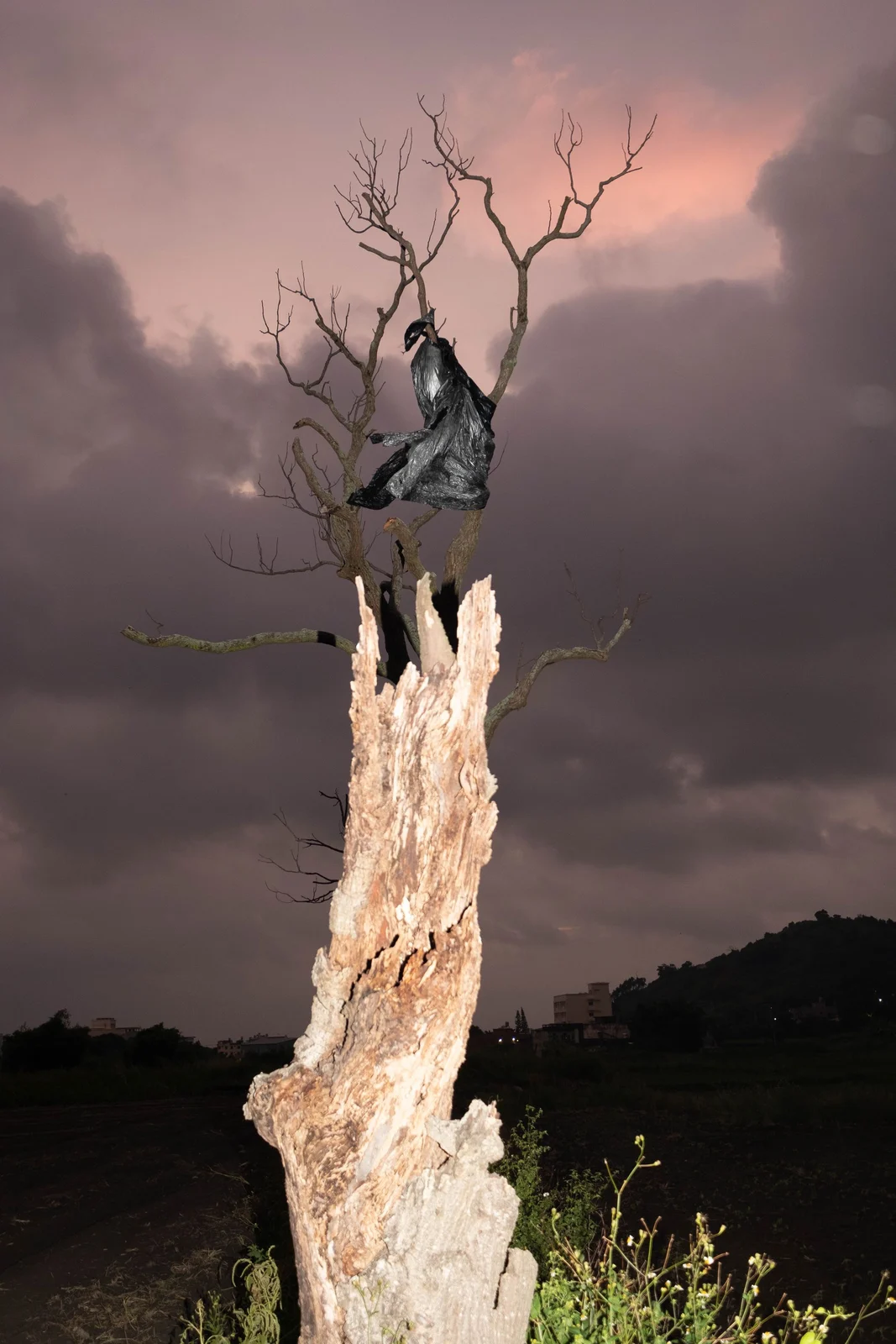
By late summer, the flowers people had left at Qingming were reduced to withered stems, or to clumps of blackened matter, buried beneath weeds grown rank once more. In this season typhoons often strike; a deep-gray sea of cloud, heavy with the coming storm, sweeps over Tiezhen Mountain and follows the mountain wall down into Tieshan village. At the southwestern foot of Tiezhen Mountain stand two withered trees side by side. One looks as though it had been struck by lightning, only half its trunk remaining. The other has been more fortunate, its body still whole; in a branch at its crown a black plastic bag has snagged, and as the strong wind blows it open, it looks like a ninja crouched at the treetop.
Riding up the mountain by the road on its southeastern side, I felt the faint coolness of late summer; on an ordinary day, with no visitors about, it is a lonely mountain road.
霸氣鯤南久寂寥 鐵砧山上柳簫簫 ——— The lordly spirit in the south of the isle has long lain desolate; on Tiezhen Mountain the willows sigh, forlorn.
殘碑一角荒祠外 付與斜陽咽暮潮 ——— Outside the ruined shrine a fragment of broken stele remains, given over to the slanting sun and the sobbing evening tide.
This poem by Hsu Tian-Kui, "Meditation on the Past at Tiezhen Mountain," carries a note of lament. For Hsu Tian-Kui, a man of the Yiwei generation (1895), the very presence of the Japanese colonial government was a constant reminder of the pain of being abandoned by the motherland; all he could do was pin his hopes on another Koxinga who would come and drive out the foreign rulers.
Hsu Tian-Kui's younger brother Hsu Tian-Te, the fifth of the Hsu brothers, once raised a Confucius stele on Tiezhen Mountain. In contrast to the lament of Hsu Tian-Kui's poem above, the Confucius stele inscription composed by Hsu Tian-Te was written after Taiwan's Retrocession, and the joy of returning to the motherland runs through its words.
日月霜露四運成焉山川草木萬類育焉修齊治平群生康焉故曰聖人與天地合其德吾華文教賴先師孔子刪述整飭遂得晃曜宇宙涵煦古今而民蒙其休 自漢高帝至魯祀以太牢歷代弗替台民遷自諸夏記載足徵可三百年惟散見野乘者固已謂始於三國矣是以典章文物一乃漢俗吾家世治儒術於先師儀行尤嚮往焉 清光緒甲午台淪於日聖跡微晦民國丙戌返我侵地道復大彰逾三歲值先師二千五百年聖誕東瀛西歐之士以及南洋吾僑咸稱慶祝憶信乎所謂凡有血氣者莫不尊親台民際曆象重光勝緣千載其誠其愉又必超越乎各地者矣 吾宅之北有山曰鐵砧披雲眺海為村高阜春秋佳日遊人時登爰擇山陽私土建樹貞岷敷陳時事以紀其盛且以識吾欽崇先師至意過而覽者或有同感云爾 ——— Sun and moon, frost and dew complete the round of the four seasons; mountains and rivers, grasses and trees nurture the myriad living kinds; through cultivating the self, ordering the family, governing the state, and bringing peace to all under heaven, the multitude of beings attain their well-being. Therefore it is said that the sage's virtue is one with that of Heaven and Earth. The letters and learning of our China rest upon the First Teacher, Confucius, who edited, transmitted, and set them in order, so that they came to shine throughout the universe, warming past and present alike, and the people received their blessing. From Emperor Gao of Han, who at Lu offered the great sacrifice of the tailao, dynasty after dynasty has kept the rite unbroken. The people of Taiwan came here from the lands of Xia; the records bear witness, and may be traced back some three hundred years—though what is scattered through the unofficial annals already holds that it began in the age of the Three Kingdoms. Thus its institutions and culture are wholly of Han custom. My family has for generations devoted itself to Confucian learning, and to the conduct and example of the First Teacher we aspire above all. In the jiawu year of the Guangxu reign of the Qing, Taiwan fell to Japan, and the traces of the sage grew dim; in the bingxu year of the Republic, our occupied land was returned to us, and the Way was once more greatly made manifest. More than three years on came the 2,500th birthday of the First Teacher, and scholars of Japan and the West, together with our overseas compatriots in the South Seas, all joined in the celebration. Truly, as it is said, among all that draw breath there are none who do not honor and hold him dear. The people of Taiwan, at this moment when the calendar and the constellations shine anew, enjoy a karmic bond that comes but once in a thousand years; their sincerity, their gladness, must surely surpass that of every other place. To the north of my dwelling there is a mountain called Tiezhen Mountain, draped in cloud and gazing out to sea, the high ground of the village; on fair days of spring and autumn travelers often climb it. And so I chose a private plot on the mountain's sunlit southern slope and raised this enduring stele of fine stone, setting forth the affairs of the time to record this grand occasion, and to make known my utmost reverence for the First Teacher—that those who pass by and read it may perhaps share in this feeling. So it is.
In this piece Hsu Tian-Te dwells on the importance of Confucius to Chinese culture and education, and on the people of Taiwan's reverence for him and their continuance of his legacy. He opens with an evocative image:
日月霜露四運成焉山川草木萬類育焉修齊治平群生康焉 ——— Sun and moon, frost and dew complete the round of the four seasons; mountains and rivers, grasses and trees nurture the myriad living kinds; through cultivating the self, ordering the family, governing the state, and bringing peace to all under heaven, the multitude of beings attain their well-being.
Because of the return to the motherland, Hsu Tian-Te was filled with hope for Taiwan's future.
台民際曆象重光勝緣千載其誠其愉又必超越乎各地者矣 ——— The people of Taiwan, at this moment when the calendar and the constellations shine anew, enjoy a karmic bond that comes but once in a thousand years; their sincerity, their gladness, must surely surpass that of every other place.
He goes on to speak of the scenery of his home—the very place where we now stand: Tiezhen Mountain.
吾宅之北有山曰鐵砧披雲眺海為村高阜春秋佳日遊人時登 ——— To the north of my dwelling there is a mountain called Tiezhen Mountain, draped in cloud and gazing out to sea, the high ground of the village; on fair days of spring and autumn travelers often climb it.
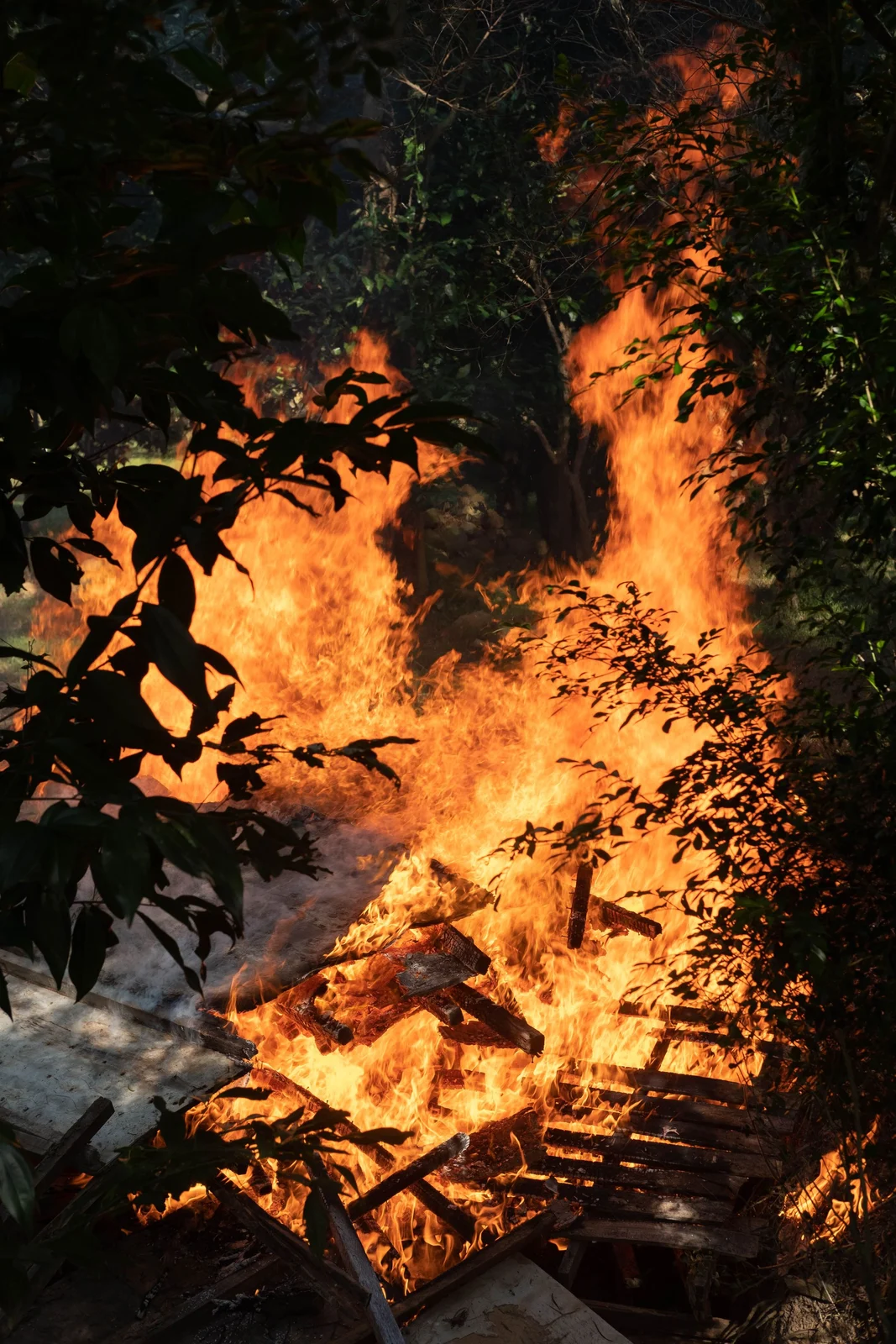
Back on the road, I went on up the mountain along the asphalt, and once again came in sight of the northern face of Tiezhen Mountain—the red sand and gravel laid bare in great swaths, as if forever on the verge of collapse. I rode, riding to the very end of the road, where I caught the smell of burning wood. I walked, walking into the woods, where I saw a wall of fire surging skyward, coming toward me. I raised my camera and took a photograph of fierce flames blazing at the summit of Tiezhen Mountain.
The Roar of the Sea
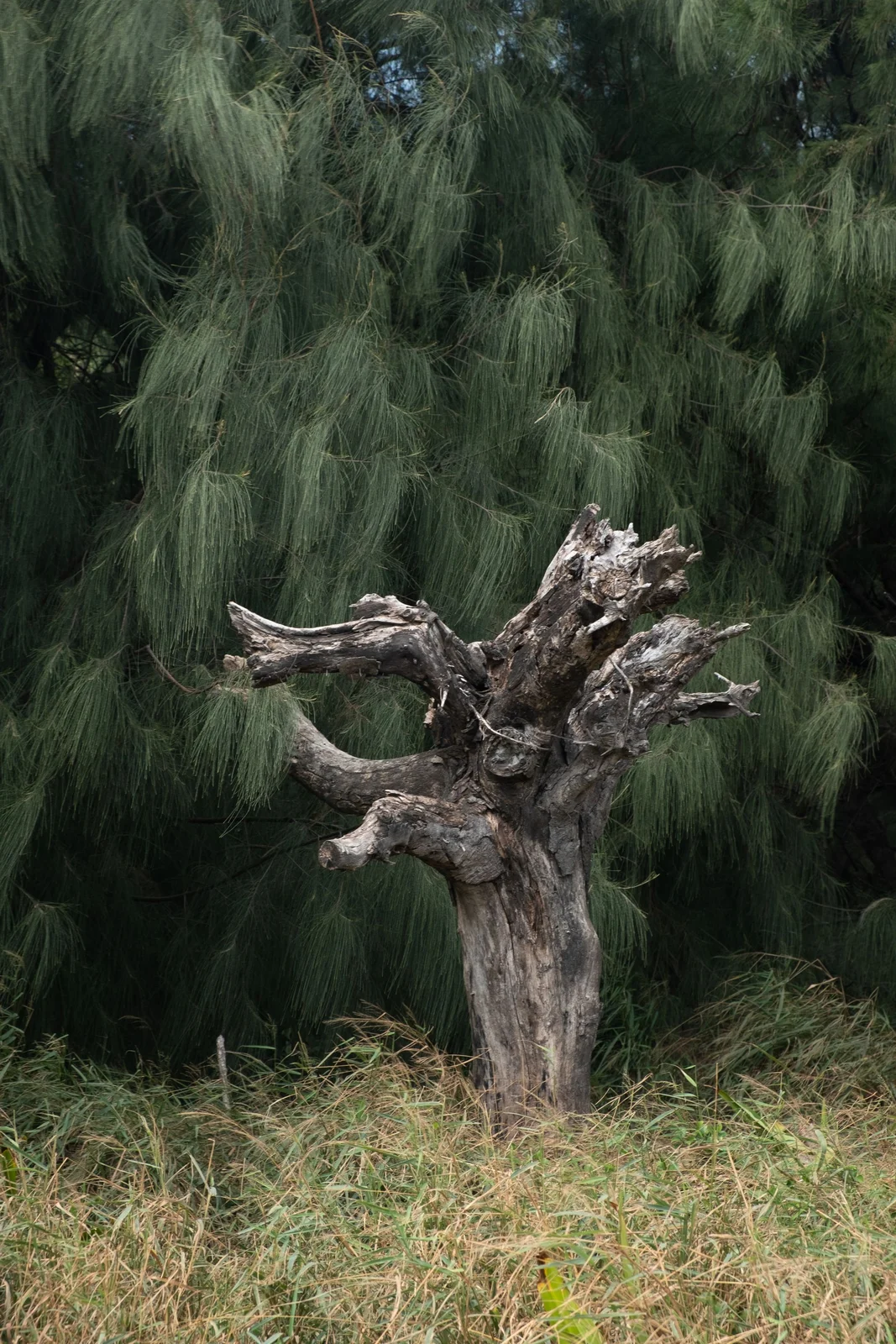
After coming down the mountain, I rode toward the sea, and my view onto Tiezhen Mountain swung a hundred and eighty degrees; now the mountain looked like a black whale resting on the Houli Plateau. The nearer I rode to the shore, the more pine groves appeared, their green light and shadow swaying in the sea breeze; the pines held strange postures that brought to mind the lines of the strange trees often seen in ink-wash paintings.
I reached the shore, and saw a pack of black dogs swimming, one after another, across the water between the sandbars to the far side. On the sand of the opposite bank was a fair-sized dune, covered with a thin layer of growth; once the pack had swum across to that solitary, sequestered dune, they would be troubled no more by the affairs of the ordinary world. On that lonely ground they rested or roamed at ease, while behind them the embankment ran on to the very end of the coastline, and the pounding of the sea against the embankment was carried on the salt-laden wind into my ears on the howling sea wind.
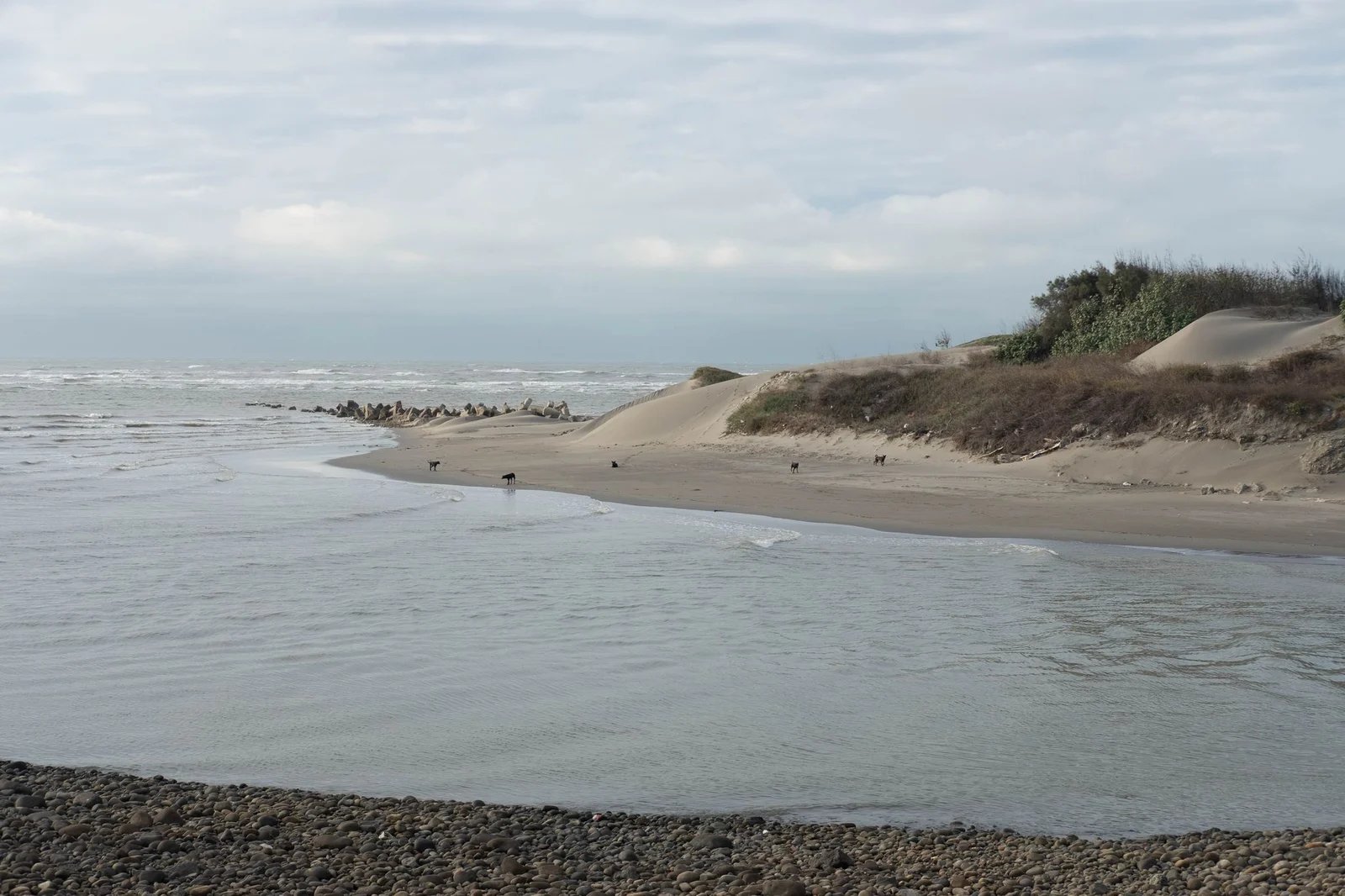
海濱人聽慣 清夢總無驚 ——— The folk of the seashore are long used to it; their tranquil dreams are never startled. — from "The Roar of the Sea," by Hsu Tian-Kui
Text: Wei-Chen Li, Tsai Chia-huan
Photography: Wei-Chen Li
Image editing: Wei-Chen Li, Chou Fang-yu
Book design: Chou Fang-yu